氢气材料用于卵巢移植保护的研究
本研究发表于《Journal of Nanobiotechnology》,由多机构团队研发出KBH₄@Gel氢生成纳米调节剂,通过将硼氢化钾纳米颗粒包封于温敏水凝胶中,实现缺血模拟的弱酸性条件下原位持续释氢,在兔卵巢组织冷冻保存与移植(OTC-T)模型中,该制剂可高效清除活性氧(ROS)、保护线粒体结构、促进移植部位血管生成并激活AMPK–TFAM–OXPHOS信号轴恢复能量代谢,160μg/ml为最优给药剂量,能显著减少原始卵泡凋亡、提升移植物活力并恢复卵巢内分泌功能,解决了 OTC-T 中缺血再灌注(I/R)损伤导致的卵泡丢失核心问题,同时为其他缺血组织的 I/R 损伤治疗提供了可转化的纳米治疗方案,研究也指出了短期冻存、未验证卵泡功能终点等局限性并提出后续研究方向。
研究背景与核心问题
生育保存需求:低生育率、人口老龄化及年轻人群恶性肿瘤发病率上升,使生育保存成为生殖医学研究重点,化疗 / 放疗的性腺毒性易导致早发性卵巢功能不全;
OTC-T 的优势与缺陷:为青春期前女孩、需紧急肿瘤干预患者提供唯一可行的生育 + 内分泌功能恢复方案,但冷冻解冻损伤和I/R 损伤引发过度氧化应激、线粒体功能障碍,导致卵泡大量丢失,移植物功能受损;
传统干预的不足:冷冻保护剂优化、抗氧化剂(白藜芦醇、硒)等手段仅能提供部分保护,无法应对 I/R 引发的持续性氧化应激和线粒体失调;
氢气的潜力与问题:氢气具有小分子、高扩散性、选择性清除毒性氧自由基的优势,在缺血性疾病中展现抗氧化、抗凋亡、促血管生成作用,但水溶性低、全身扩散快,难以在卵巢移植物部位实现持续生物利用。
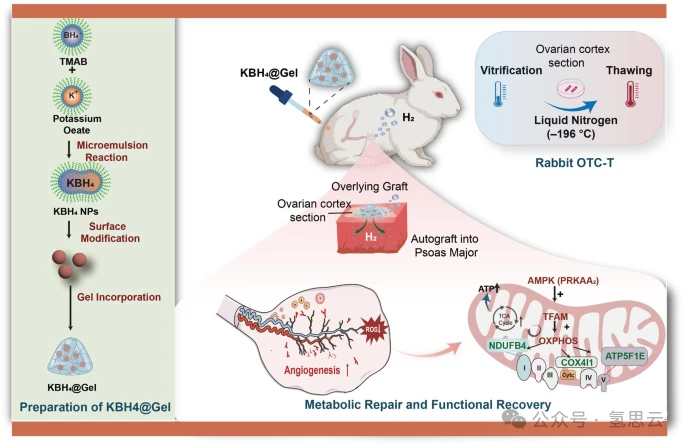
Ischemia–reperfusion (I/R) injury occurring during ovarian tissue cryopreservation and transplantation (OTC-T) induces mitochondrial dysfunction and oxidative stress, leading to pronounced follicular loss and compromised graft performance—key challenges that limit transplantation success. Here, we present a hydrogen-releasing nanomodulator composed of potassium borohydride nanoparticles embedded within a thermosensitive hydrogel (KBH₄@Gel), designed to achieve sustained in situ hydrogen (H₂) generation for metabolic repair and ovarian function restoration. Upon local administration, the thermosensitive gel undergoes a sol–gel transition, encapsulating KBH₄ nanoparticles and enabling controlled H₂ release under mildly acidic, ischemia-mimicking conditions. Compared with free KBH₄ nanoparticles, KBH₄@Gel exhibits refined release kinetics and extended H₂ bioavailability, thereby providing long-term antioxidative protection. Mechanistic investigations demonstrate that KBH₄@Gel efficiently scavenges reactive oxygen species (ROS), preserves mitochondrial architecture, promotes angiogenesis at the graft site, and enhances ATP synthesis, ultimately reducing primordial follicle apoptosis and improving graft viability. This study introduces a precise and durable nanotherapeutic platform for metabolic repair and functional recovery in ovarian tissue transplantation, offering a broadly translatable strategy to mitigate I/R-induced injury across reproductive and other ischemic tissues.